

Here’s the part nobody tells you about hotel renovation costs. You sit down expecting a rough number — and what you get is either far higher than expected, or so low that it doesn’t feel realistic.
That’s because hotel renovation cost per room is never a fixed number. A budget hotel and a luxury property operate on completely different cost structures. Even two similar hotels in different cities can end up with very different renovation budgets. That said, there are realistic ranges you can plan around.
In 2026, most hotel renovation costs in the U.S. fall between $4,500 and $48,000 per room, depending on the scope, location, and level of finish.So, how much does it cost to remodel a room today? The answer isn’t one-size-fits-all. Costs may vary depending on the age of your building, the amount of change you are going to make, and the location of your hotel.
In this guide, we will take you through real numbers and smart tips to guide you when renovating with confidence.
Average Cost of Renovating a Hotel Room in 2026 (in U.S.).
Altering the look of a hotel room in 2026 is not a matter of esthetics only – it is a tactical step to keep up with the market, which is ruled by experience. On paper, the average hotel renovation cost per room in 2026 ranges from $4,500 to $48,000. But that range only makes sense once you understand what’s behind it.
A simple refresh — new paint, updated lighting, and replacement furniture — can stay on the lower end. A full renovation, especially one that includes bathrooms, electrical systems, or layout changes, moves quickly into the higher range.
The mistake many hotel owners make is assuming they’ll land somewhere in the middle. In reality, most projects lean clearly toward one end or the other.
Hotel Renovation Cost Per Room by Hotel Class
Here’s what you can expect based on your property’s classification:
| Hotel Class | Typical 2026 Renovation Cost Per Room | What’s Included |
| Economy Hotels | $4,310 – $5,963 | Basic flooring, fresh paint, updated lighting, mattress replacement, and minor bathroom upgrades |
| Midscale Hotels | $6,000 – $18,000 | New furniture, soft goods (curtains, carpets), moderate bathroom, and tech improvements |
| Upscale Hotels | $18,000 – $33,000 | Custom furniture, bathroom redesign, high-end finishes, tech integration |
| Luxury Hotels | $33,000 – $46,419+ | Trendy designs, relaxing bathrooms, high-tech room features, visual art, and auditory enhancements |
This high range of cost covers the light “soft renovations” as well as the whole “gut-and-redo” remodels. For instance, a simple refresh of finishes can cost much less than a renovation that will involve plumbing works or re-planning.
Differences in Regional Costs around the U.S.
Location of your hotel has a great effect on costs of renovation. Labor rates, availability of contractors, permitting and yes, even the weather, can impact your bottom line.
Here’s a general idea of how regions compare in 2026:
| Region | Cost Impact |
| West Coast (CA, WA, OR) | High labor and regulatory costs; expect to pay 15–25% more |
| Northeast (NY, MA, NJ) | Urban demand and union labor push costs 10–20% above the national average |
| South (FL, TX, GA) | Competitive pricing; many areas are 5–10% below the national average |
| Midwest (IL, OH, MI) | Typically average or slightly lower costs due to moderate labor pricing |
| Mountain States (CO, UT, AZ) | Rising demand may bring prices 5–10% above average |
Recommended Related Reading: 12 Hotel Renovation Ideas to Revitalize Your Property
Top Tips for Small Hotel Bathroom Design in 2026

What Affects Hotel Renovation Cost Per Room?
Renovation of a hotel in 2026 does not only entail the choice of stylish furnishings and fresh colors. There are a number of important factors behind the renovation costs throughout the U.S., and learning about them will allow hotel owners to make a smarter financial decision and eliminate the possibilities for unexpected costs. Some of the most important factors are the availability of material, labor cost, and compliance with new codes and industry standards.
Materials and Supply-Chain Pressures
Material prices are still volatile even in the year 2026 as a result of world supply chain problems. Costs of such items as flooring, furniture, fixtures, and plumbing components have all increased by 5-15% compared with previous years. Manufacturing and shipping delays (particularly on imports) can also blow out project timelines and drive storage or labor costs up.
The selection of locally available or accessible material could help reduce budget overruns and speed up the completion of the project. Working with reliable building materials manufacturers guarantees a consistent quality and prompt supply of the materials, and it is important in controlling renovation costs.
Labor Availability and Wage Growth
Labor is another factor that tends to be underestimated early on. In most areas, particularly in urban areas and high-demand states such as California, New York, and Florida, there is a shortage of skilled construction workers. Consequently, the wages have gone up, with the rates for general contractors and specialty trades also going up by 7-10% during the last year. The hotel proprietors should expect a shortage of labor and provide a time and cost buffer for the hiring and project completion.
Scope of Work
Scope is one of the most important — and most misunderstood — parts of renovation planning. A project may begin as a simple refresh: updating finishes, replacing furniture, improving lighting. But once work begins, additional needs often start to surface.
A wall that needs adjustment. A system that no longer meets current standards. A layout that doesn’t function as well as expected. Individually, these changes make sense. In many cases, they even improve the final result. But together, they can shift the project from a light upgrade to something much more extensive.
This is where many budgets begin to stretch — not because of poor decisions, but because the true scope becomes clearer over time.
Existing Building Condition
The condition of the existing building plays a major role in how predictable a renovation will be.
With newer properties, systems are usually closer to current standards, and fewer surprises appear during construction. Older buildings are different. What looks like a straightforward upgrade on the surface can become more complex once systems are opened up. Electrical wiring, plumbing lines, and structural elements may require more work than initially expected.
This doesn’t mean older properties are problematic — it simply means they carry more unknowns. And those unknowns are often what drive adjustments in both timeline and budget.
Code and Standard Upgrades
Renovations usually result in the need to comply with the new codes of building, ADA, and energy efficiency. These are necessary updates, but they can add thousands of dollars to the price of each room. For instance, replacing HVAC systems or retrofitting bathrooms for accessibility usually involves more initial costs, but entails long-term benefits as well as legal compliance.
This is one of the more common reasons renovation budgets exceed initial expectations — not because of poor planning, but because certain requirements only become clear during execution.
Breaking Down Costs by Area
The cost of renovation of a hotel is not uniform in all aspects; neither does it have equal impact. It is important to know how you will allocate your budget in various parts of the property so that you can prioritize on areas to invest on and avoid overspending. As below is the breakdown of where most of the renovation dollars are spent and why each area is of importance.
FF&E (Furniture, Fixtures & Equipment)
FF&E is often one of the largest and most underestimated parts of the renovation budget.
At first glance, individual items may not seem overly expensive. But when multiplied across dozens or hundreds of rooms, the total adds up quickly. Every element the guest interacts with — beds, seating, lighting, storage, accessories — falls into this category.
The challenge here isn’t just managing cost. It’s balancing durability, comfort, and design in a way that supports both guest experience and long-term use. Small decisions at the item level can have a significant impact when applied across the entire property.
Sustainability and Technology
Sustainability and technology have become standard considerations in modern renovations.
Energy-efficient lighting, smart climate systems, and water-saving fixtures all contribute to higher upfront costs. But they also play a role in long-term operating efficiency and guest expectations. In many cases, these features are no longer optional. They are increasingly tied to brand standards, regulatory requirements, or competitive positioning.
The focus has shifted from whether to include them to how to implement them effectively. Done right, they support both cost control over time and a more modern guest experience.
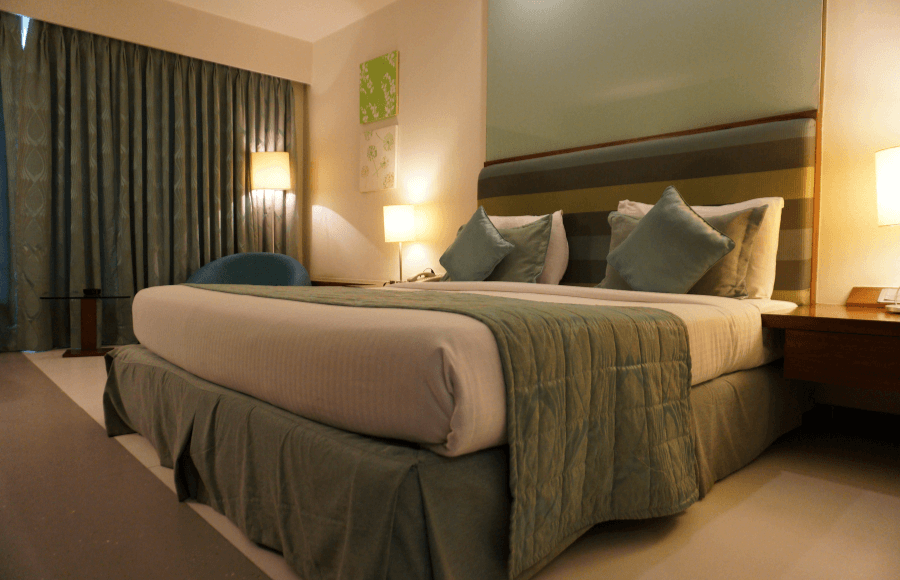
Guestrooms and Bathrooms – 60 – 70% of the Overall Budget
Guestrooms and bathrooms consume the biggest part of the renovation budget, and it is no surprise. This is where the guests spend most of their time, and their experience has a direct implication on your Average Daily Rate (ADR) & online reviews. As for this area, you should be counting 60–70% of your total renovation budget. Key upgrades include:
● New furniture (case goods such as beds, nightstands,and desks)
● Flooring (carpet or luxury vinyl plank).
● Lighting and electrical updates
● The plumbing fixtures in the bathroom, vanities, and tile
Such improvements can make the room experience more modern and can support higher nightly rates.
Public Spaces – $150 – $500 per Square Foot
Lobbies, restaurants, bars, meeting rooms and wellness spaces have a bearing on guests’ impression and can generate further revenue. The prices range dramatically from $150 to $500 per square foot, according to your design objectives. Although these spaces play a significant role in the image of your brand, the renovations should be phased very carefully to prevent significant disruptions and lost bookings.
Exterior and Infrastructure – 5% – 10% of the Budget
Overlooked, sometimes, exterior updates and back-of-house systems are necessary. Roof, façade improvements, site drainage, and MEP (Mechanical, Electrical, Plumbing) improvements normally account for 5–10% of your budget. Although not always visible, these upgrades make energy efficiency, safety, and curb appeal better, which all help to achieve long-term ROI.
Practical Budgeting Methods
Renovations of a hotel are not simple undertakings which can be quoted ball park figures. In order to prevent surprises in overrun and downtime, smart budgeting is necessary. Below are three tested ways in which hotel owners in the U.S. are using in 2026 to stay on track and get the highest returns.
Creating a Line-Item CapEx Plan
Take a detailed capital expenditure (CapEx) plan. Divide each and every cost into categories: guestroom furnishings, flooring, plumbing, lobby upgrades, mechanical systems, and professional services. Each line item should have cost, time frame, and vendor estimate. This level of detail provides you with more clarity of where your money is going, where it can end up high, and also where you can cut if necessary. It also comes in handy when making an application for financing or presenting to the stakeholders.
Setting and Managing Contingencies
Even the best of the planned projects always end up facing surprises, hidden plumbing problems, late delivery of shipments, or construction delays due to bad weather. That is why it is smart to put a contingency buffer of 10-15% of the total budget for renovation. Use it for the real unexpected expenses and keep it separate from other expenses so that you know what was unforeseen. Do not tap on this reserve for design upgrades or changes until it is absolutely necessary.
Phasing to Keep Rooms Revenue-Active
One of the ways of minimizing revenue loss through maintenance is leaving some of the rooms open during renovations. Carry out renovations in phases or zones, meaning alternating floors, or focusing on a wing at a time, so that the hotel remains partially operational. Phasing is effective if there is coordination between the contractors, the hotel staff, and housekeeping to ensure minimal disruption to guests with a maintained occupancy and revenue.
Recommended Related Reading: Hotel refurbishment: 10 key factors for success
Get Partnered with George Solution to Finish Your Hotel Makeover
Your hotel renovation is not just a building project but an investment in your brand’s future. From single upgrade to portfolio-wide renovation, George Solution is the trusted partner that will help you to make your vision a reality, on time and on budget.
With more than a decade of experience in the U.S. hotel renovations, George Solution has managed to transform properties from economy lodges to luxurious resorts. Our team is in the hospitality business, not the construction business. We work in a seamless cooperation with hotel management, we don’t cross the line of guest privacy, and we produce stunning results that increase your ADR, occupancy rates, and online reviews.
Conclusion
It is a strategic venture to renovate a hotel room in 2026, and it needs due consideration, budgeting, and the right partners. From the costs that you can expect to pay on average per room to the timing to invest in high-impact upgrades and how to account for regional pricing differences, every piece of the puzzle makes or breaks your long-term ROI.
With the division of costs by region, the establishment of contingency buffers, and staging renovations so that rooms are not eliminated, hoteliers can make their properties modern without losing profitability.
But when you are ready to change the game on your guest experience and increase your revenue, George Solution is here to assist you with industry knowledge, transparency on the costs, and unbeatable reliability for each renovation project.
FAQ
How much does it cost to renovate a hotel room in 2026?
In most cases, hotel renovation costs range from $4,500 to $48,000 per room in 2026.
Where your project falls within that range depends on a few key factors — mainly the scope of work, the condition of the building, and the location of the property. A light cosmetic update will stay closer to the lower end, while full renovations involving bathrooms, systems, or layout changes can move quickly toward the higher range.
What is the most cost-effective way to renovate a hotel room?
The most cost-effective approach is usually to focus on high-impact, visible upgrades rather than structural changes.
Updating finishes like paint, flooring, lighting, and furniture can significantly improve the guest experience without dramatically increasing costs. Structural modifications, on the other hand, tend to introduce complexity, longer timelines, and higher labor requirements.
In many cases, thoughtful design decisions deliver better value than simply increasing the budget.
How long does a hotel renovation typically take?
Timelines can vary widely depending on project size and scope.
A small-scale refresh may take a few weeks per phase, while a full renovation can extend over several months — especially if the work is done in stages to keep part of the property operational.
The biggest factor isn’t just the amount of work, but how well the project is planned and coordinated.
What causes hotel renovation costs to increase?
Cost increases are usually not caused by a single factor.
More often, they come from a combination of elements — changes in scope, delays in materials or labor, and unexpected conditions discovered during construction.
Upgrades related to building codes, accessibility, or system improvements can also add to the budget, especially if they weren’t fully accounted for at the planning stage.