

Type “best kitchen countertop material” into a search engine, and you will get a hundred confident answers. The problem? Most of them are written by someone selling exactly one material. The quartz manufacturer pushes quartz, and the natural stone importer pushes granite.
At George Solution, we manufacture, supply, and install all of these materials alongside the custom cabinetry that supports them. Granite, engineered quartz, sintered stone, marble, and wood—they all move through our production lines.
Because we see exactly how each one performs in real-world kitchens years after installation, we can give you the honest answer those other articles won’t.
There is no single “best” countertop material. There is only the best material for your specific cooking habits, design vision, and budget. Here is our unfiltered breakdown of the market, including real installed costs and the daily maintenance truths you need to know.
The “Big Four”: Dominating the Modern Kitchen
If you are building a premium kitchen today, your decision will likely come down to one of these four primary materials.
1. Engineered Quartz: The Zero-Maintenance Favorite
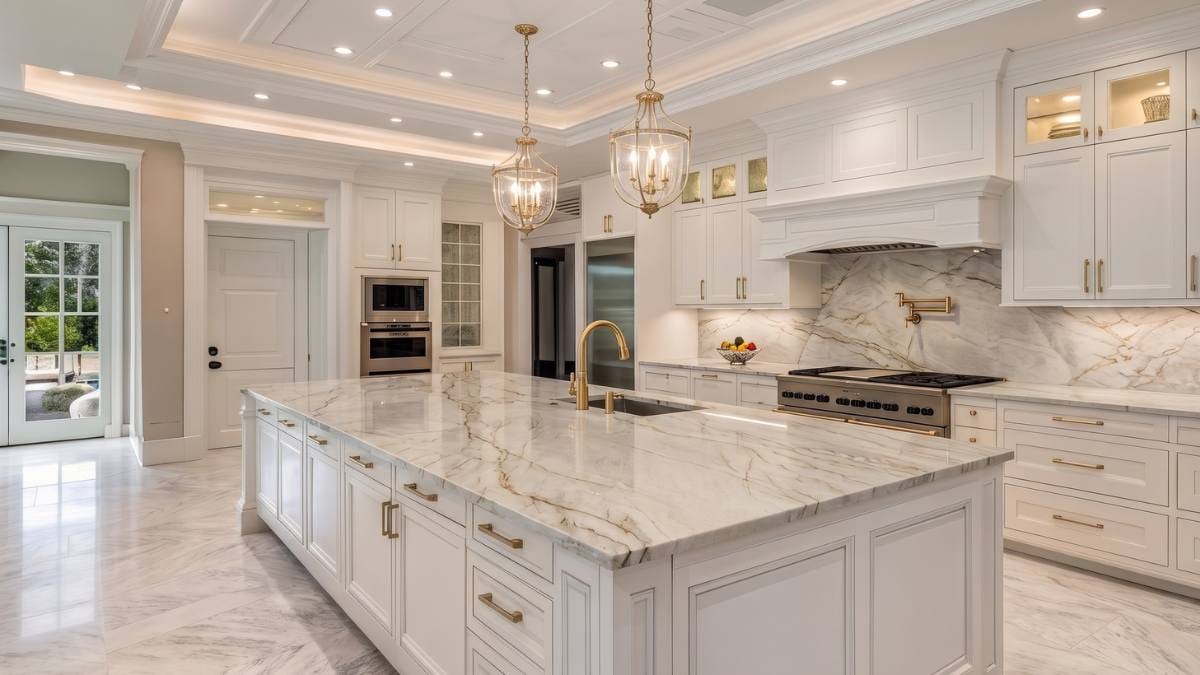
Engineered quartz is the best-selling countertop material in America, and its winning formula is simple: stone-level durability with absolutely nothing to remember. Manufactured by binding crushed natural quartz with polymer resins, the resulting surface is completely non-porous.
This means wine, coffee, and turmeric wipe away easily whenever you finally get to them. You never have to buy or apply a chemical sealer. For busy families, rental properties, and anyone whose eyes glaze over at the word “maintenance,” quartz is the correct default answer.
However, its two honest weaknesses are heat and sunlight. The same polymer resins that make quartz stain-proof will scorch under a hot pan—roughly 300°F is the danger line. Furthermore, prolonged exposure to UV rays will cause the resins to yellow, which rules out quartz entirely for outdoor kitchens.
- Estimated Cost: $50 – $150 per sq. ft.
- Choose it if: Low maintenance tops your list, you want perfectly predictable color across a large kitchen island, or you are renovating a home for resale.
- Skip it if: Hot cookware routinely lands directly on your counters, or you are building an outdoor BBQ island.
Related Article: Beyond Marble: Why Aqua Fusion Quartzite is the Future of Premium Kitchens
2. Sintered Stone & Porcelain: The Performance Innovator
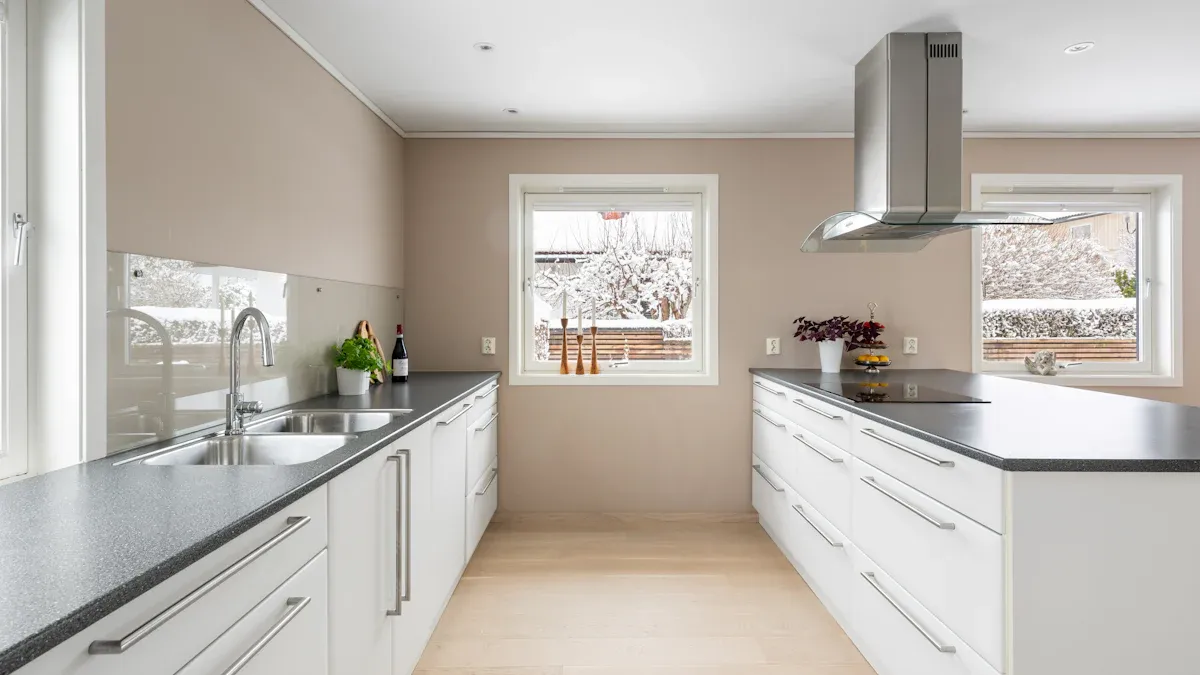
Sintered stone (and large-format porcelain) is the newest serious contender, and on raw surface performance, it is arguably the best of all. It is manufactured by mimicking the earth’s natural volcanic pressure, fired at over 1,200°C.
That means hot pans mean nothing to it. You can pull a cast-iron skillet out of a roaring oven and set it directly on the counter.
It has zero porosity, so nothing stains, and it is fully UV-stable, making it the premier outdoor countertop. Thin profiles and massive seamless slabs give it a modern architectural character that nothing else matches.
The caveats live literally at the edges. This ultra-hard material can be brittle at the corners under sharp impact. Because of its extreme rigidity, results depend heavily on the fabricator’s experience—it requires specialized tools to cut and finish properly without chipping.
- Estimated Cost: $60 – $150+ per sq. ft.
- Choose it if: You are building an outdoor kitchen, a heat-heavy cooking space, or an ultra-modern design built on seamless, monumental surfaces.
- Skip it if: Your household is incredibly rough on counter edges, or your budget cannot accommodate the specialized fabrication labor.
3. Granite: The Undefeated Value Champion
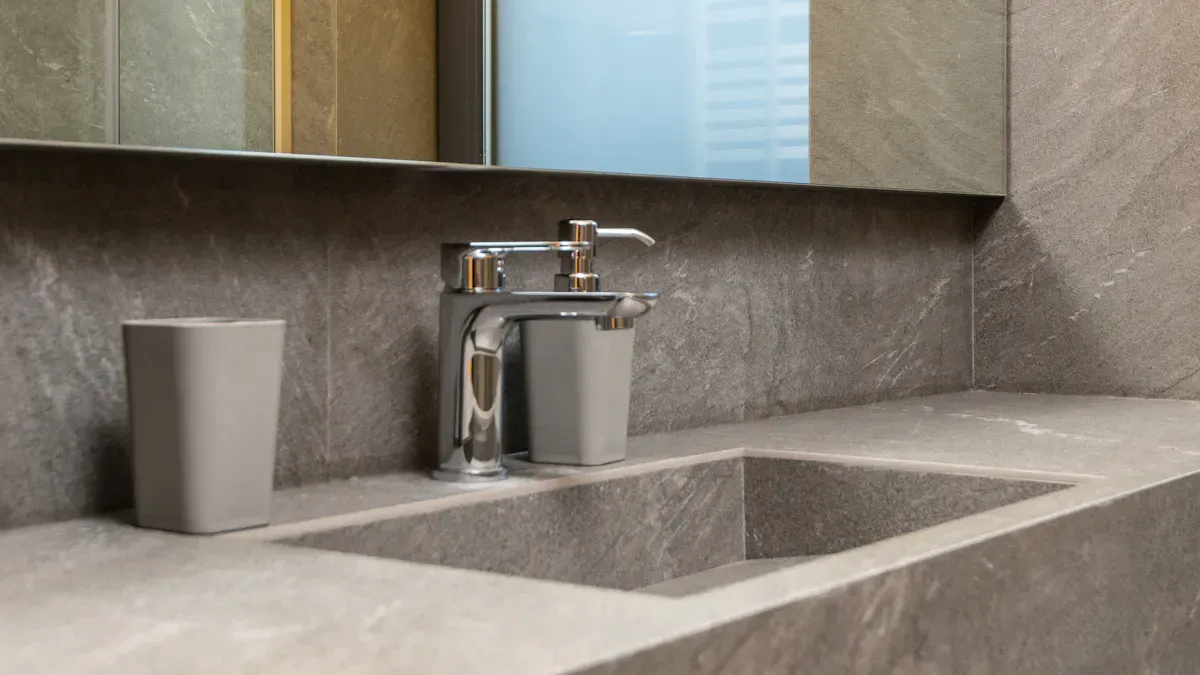
Granite built the modern countertop industry, and there is a reason it is still everywhere. Nothing else delivers real natural stone, a Mohs hardness of 6 to 7, and full heat immunity at this price point. It shrugs off hot pans, resists knife scratches, and easily handles daily kitchen chaos.
Granite’s only real “problem” is its reputation from the early 2000s, when busy, speckled brown slabs were installed everywhere. Modern granite selections look nothing like that—today we see flowing white-and-gray slabs and dramatic dark stones in leathered finishes that fit 2026’s minimalist palette perfectly.
The trade-off is its natural porosity. To keep a granite countertop performing at its peak, you must commit to a 15-minute routine of applying a penetrating stone sealer every 1 to 3 years.
- Estimated Cost: $45 – $120+ per sq. ft.
- Choose it if: You want maximum durability per dollar, real natural stone, full heat immunity, and you don’t mind a quick annual sealing routine.
- Skip it if: You need perfectly uniform, solid colors across a massive kitchen or demand absolutely zero maintenance.
4. Natural Marble: Beautiful, Demanding, and Historic
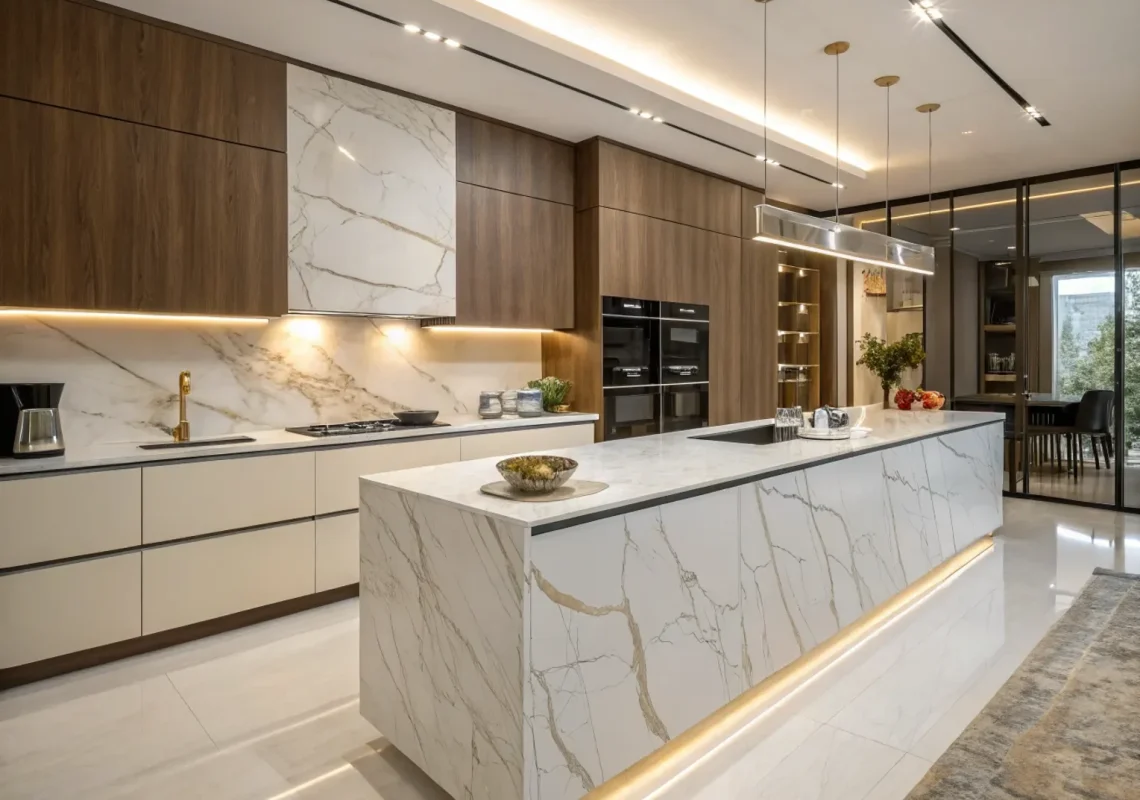
Let’s be honest about marble, because so much marketing isn’t. Marble is the most beautiful stone humans have ever built with—it has meant luxury for thousands of years. Its naturally cool surface makes it the historical favorite for professional bakers. However, it is objectively the most demanding kitchen surface on this list.
It is a softer stone, meaning it scratches easily. More importantly, its natural calcite chemistry means that lemon juice, vinegar, and wine will chemically “etch” (dull) the surface on contact.
Sealing cannot prevent this, because etching is a chemical reaction, not absorption. Why does it persist in kitchens? Because for the right owner, the aging is the appeal. The etches and faint scratches merge into a patina—the lived-in beauty of a Parisian bistro.
- Estimated Cost: $70 – $200+ per sq. ft.
- Choose it if: You love the idea of a living patina, you are designing a dedicated baking station, and you accept the careful upkeep.
- Skip it if: You will mourn the first etch mark or water ring. (Pro tip: If you love the look but hate the maintenance, choose a marble-patterned Quartz or Sintered Stone instead).
Niche and Budget Alternatives: The Honest Truth
While the Big Four dominate, other materials serve specific architectural needs or budget constraints. Here is how they actually perform:
- Butcher Block ($30–$150/sq.ft): Brings incredible warmth to farmhouse or cozy modern designs. The Catch: Wood rots. It requires rigorous oiling, and if water sits around the sink area, it will warp and turn black.
- Stainless Steel ($75–$150/sq.ft): Unmatched for commercial hygiene and heat resistance. The Catch: It is loud when you set down pots, it constantly shows fingerprints, and it scratches immediately. It gives a cold, industrial feel that isn’t for everyone.
- Poured Concrete ($65–$135/sq.ft): Highly customizable for raw, industrial lofts. The Catch: It is exceptionally heavy, highly porous (demands strict sealing against stains), and will predictably develop hairline cracks as the house settles.
- Terrazzo ($75–$150+/sq.ft): Offers a vibrant, retro-artistic flair with embedded chips of glass and marble. The Catch: While highly durable, the cement base is porous and requires regular sealing to maintain its pristine look.
- Laminate ($20–$50/sq.ft): The undisputed budget floor. It looks far better today than it did a decade ago. The Catch: If water seeps into the seams, the particleboard underneath will swell and permanently ruin the counter. It cannot handle heat or knives.
The Three Showdowns Buyers Actually Face
If you are stuck between materials, you are likely facing one of these three classic mid-market decisions:
- Granite vs. Quartz: This reduces to one question—which chore do you prefer? Granite asks for a brief sealing session every few years and rewards you with total heat immunity. Quartz asks for permanent trivet discipline (no hot pots) and rewards you with never having to seal your counter again.
- Quartz vs. Sintered Stone: This is the emerging modern-kitchen decision. Both are non-porous and maintenance-free. The split is heat and edges. Sintered stone laughs at hot pans but can chip at corners under hard impact; quartz forgives impacts but scars under heat.
- Natural Marble vs. Quartzite: This is the luxury natural-stone decision. Both deliver breathtaking veined slabs. If you want the stone at year fifteen to look exactly like the day it was installed, you want Quartzite. If you find perfect surfaces sterile and love the idea of a counter that records your family’s history, you want Marble.
Related Article: Natural vs. Artificial Stone: How to Choose Decorative Stone for Your Home
The Mistake That Outranks Material Choice
After thousands of global installations, here is the contractor’s truth: fabrication and structural integration affect your daily experience far more than the material you select.
A well-templated entry-level granite counter will outperform a sloppily installed exotic sintered slab every time. Seam placement, edge polish, sink reveals, and proper overhang support are the invisible factors that dictate longevity.
More importantly, your countertop does not float. Heavy natural stones and ultra-dense sintered slabs require precision-engineered kitchen cabinets to handle the immense weight safely. Dropping a 600-pound slab of granite onto cheap, flimsy base cabinets is a recipe for structural failure.
At George Solution, we do not just sell raw materials. We engineer the complete aesthetic. By manufacturing both the premium countertops and the custom cabinetry that supports them, we ensure flawless integration, precise load-bearing support, and a seamless installation process.
Ready to stop guessing and start building? Contact our engineering and design team today to discuss your project parameters and get a precise material quote.
Frequently Asked Questions
What is the most durable kitchen countertop material?
If “durable” means resisting scratches, stains, and impacts without any maintenance, Engineered Quartz is the top choice. However, if “durable” means surviving extreme heat from hot pans and direct sunlight without damage, Sintered Stone (Porcelain) and Natural Granite are the most durable options on the market.
Is quartz better than granite?
Neither is universally better; it depends on your lifestyle. Quartz is better for busy families who want a zero-maintenance, stain-proof surface but are willing to use trivets for hot pots. Granite is better for serious cooks who want to place hot pans directly on the counter and don’t mind spending 15 minutes a year applying a stone sealer.
Can I put hot pans directly on quartz countertops?
No. While quartz is incredibly strong, it is manufactured using polymer resins. These resins can scorch or permanently discolor when exposed to extreme heat (typically anything over 300°F). You must always use a trivet or hot pad with a quartz countertop. If you want a heat-proof surface, choose Sintered Stone or Granite.
What is the easiest kitchen countertop to maintain?
Engineered Quartz and Sintered Stone are tied for the easiest maintenance. Both are 100% non-porous, meaning they never need to be sealed, oiled, or professionally polished. You can clean them daily with just warm water and a mild dish soap.