

The laundry room is usually the hardest-working room in the house, yet it is almost always the last one to get any real design attention. Most of us just live with a couple of flimsy wire shelves, a cramped floor space, and detergent bottles that constantly tip over.
Upgrading to custom laundry room cabinets does a lot more than just hide the clutter—it turns a frustrating weekly chore into a space that actually works with you. On average, homeowners spend between $1,200 and $4,000 updating their laundry rooms, with cabinetry taking up the largest share of that budget.
If you are thinking about turning that chaotic corner into a clean, functional space, here is a realistic look at what custom laundry cabinets cost, what drives the price, and how to plan your layout without overspending.
Overview of Custom Laundry Cabinets
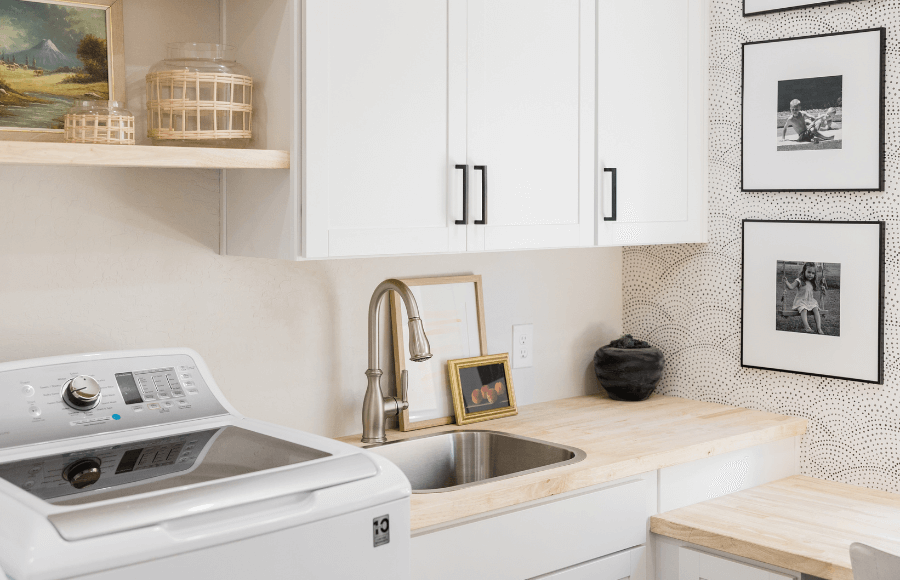
Unlike standard cabinets you pick up at a big-box store, custom laundry cabinets are built around the exact quirks of your room. Laundry spaces are notorious for awkward corners, exposed plumbing, and tight clearances.
Custom units let you use every usable inch—whether that means building a tall, narrow pull-out for ironing boards or running a seamless folding counter right over your front-loading machines.
More importantly, they change how you use the room. Instead of tripping over plastic laundry baskets on the floor, you can tuck pull-out hampers behind closed doors.
Instead of hanging damp shirts on the back of the doorway, you can build a sturdy hanging rod right beneath your upper cabinets. And because you choose the door styles and finishes, the room finally feels like a cohesive part of your home rather than an afterthought.
Importance of Knowing the Costs
Before you start saving inspiration photos, it helps to have a realistic number in mind. Laundry rooms are small, which makes it surprisingly easy to underestimate how quickly custom woodwork, countertops, and specialized hardware can add up.
Knowing the typical price ranges upfront helps you decide where to splurge and where to save. For instance, you might decide that soft-close drawers and moisture-resistant finishes are worth every penny, while choosing a simpler door profile to keep the budget in check.
Having a clear financial baseline also makes it much easier to decide whether you truly need fully custom cabinetry or if semi-custom units will do the trick.
How Much Do Custom Laundry Cabinets Cost?
Pricing for laundry cabinetry depends heavily on how much wall space you are covering and how intricate the interior storage gets. Here is how the numbers generally break down in the U.S.
Overall Price Range
Individual custom laundry cabinets typically run anywhere from $200 to $2,000 per unit, depending on their size and internal hardware. For a complete laundry room cabinet setup, most homeowners spend between $1,500 and $5,000. A basic laminate setup sits on the lower end of that spectrum, while solid wood cabinetry with built-in organizers pushes toward the top.
To give you a clearer picture of what your money buys, here is how typical layouts usually price out:
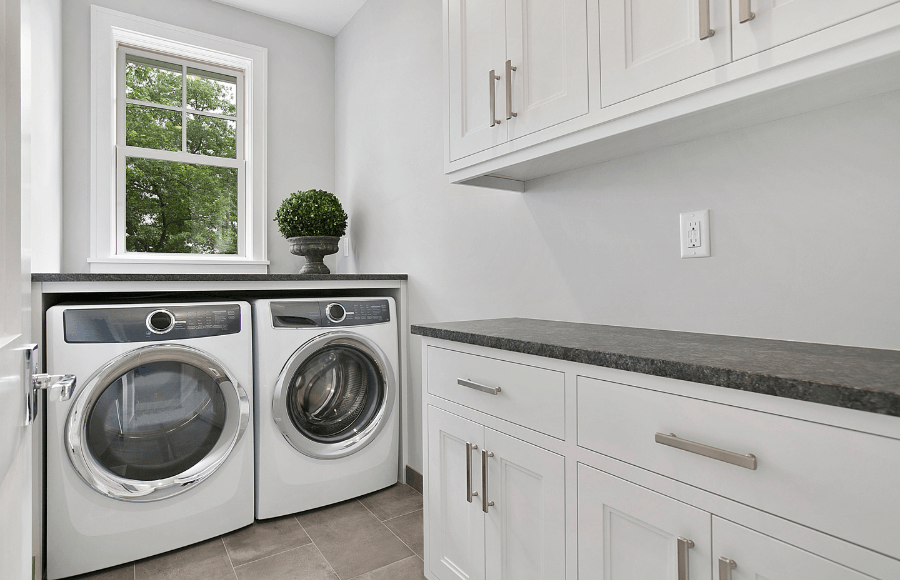
Basic Storage ($800 – $1,500): A straightforward row of upper cabinets mounted above the washer and dryer to keep detergents and supplies out of sight.
The Classic Setup ($1,500 – $3,000): Both upper and lower cabinets paired with a continuous countertop for sorting and folding clothes.
The Ultimate Organizer ($3,500 – $5,000+): A full built-in system featuring tall utility pantries for mops and vacuums, pull-out hampers, and dedicated drying or ironing stations.
Cost Per Linear Foot
Many cabinetmakers quote projects by the linear foot. In the U.S., custom laundry cabinets generally average between $500 and $1,200 per linear foot. That baseline figure usually covers the cabinet boxes, doors, and standard hardware.
If you want to estimate your own space, simply measure the length of the wall where you plan to put cabinets. Keep in mind, though, that linear-foot pricing is just a starting point—adding specialty pull-outs, custom paint, or tall pantry towers will nudge the final quote higher.
Recommended Related Reading: Standard Closet Dimensions: A Complete Guide for Every Space
Key Factors Affecting Cost
No two laundry rooms are priced the same. Beyond the sheer number of cabinets, a few practical factors will have the biggest impact on your final invoice.
Size and Layout Considerations
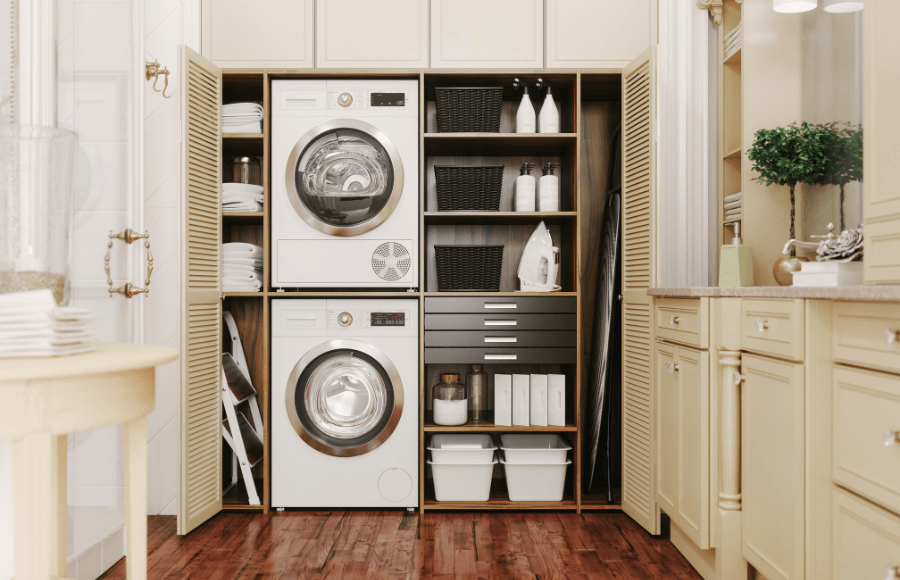
Naturally, a compact hallway alcove needs fewer cabinets than a dedicated walk-in laundry room, which keeps material costs down. However, layout complexity matters just as much as square footage. If your room has awkward plumbing lines, a low window, or stacked washers and dryers, the cabinets have to be engineered around those obstacles.
One rule of thumb that saves a lot of headaches: always plan your cabinets around your appliances, not the other way around. Front-loading washers and dryers can add up to 20 inches to their depth when the doors are swung wide open.
If you don’t measure with the doors open—or account for the extra height of washer pedestals—you can easily end up with a beautiful new cabinet drawer that collides with your dryer door.
Material Selection
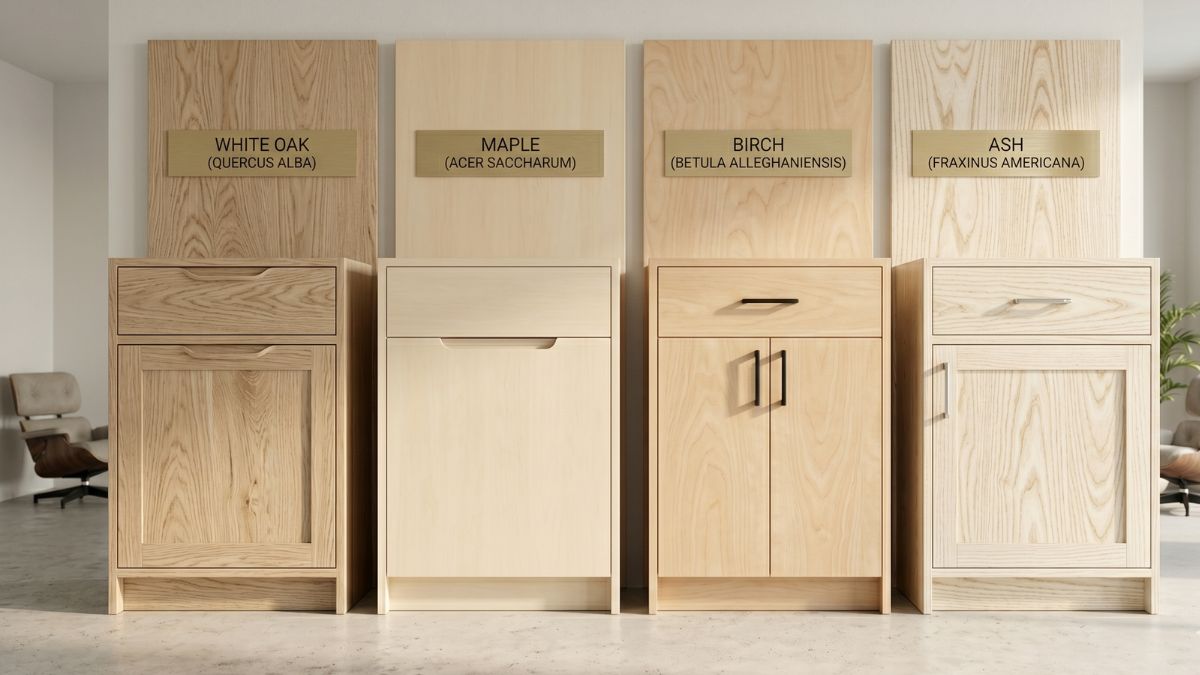
Laundry rooms deal with warm air, lingering humidity, and the occasional splash of bleach or liquid detergent. Choosing the right material isn’t just about aesthetics; it’s about making sure your cabinets don’t swell or peel a few years down the road.
MDF (Medium-Density Fiberboard): A budget-friendly choice with an ultra-smooth surface that takes paint beautifully. The catch with MDF is that it swells if water gets into the core, so the quality of the edge-sealing matters tremendously. When properly sealed at the factory, it holds up well in modern laundry spaces.
Birch: A dependable, mid-priced real wood option. It takes stain evenly and offers a solid balance of durability and affordability if you want genuine hardwood without the premium price tag.
Maple: Slightly more expensive than birch, maple is dense, strong, and has a clean, subtle grain. It’s a go-to choice for mid-range and high-end painted or stained cabinetry.
White Oak: A top-tier hardwood prized for its rich grain and natural resistance to moisture. It handles the humid environment of a laundry room exceptionally well, though it sits at the higher end of the budget.
Cherry: One of the pricier hardwoods, known for its smooth texture and warm tone that deepens gracefully over time. It’s best suited for homeowners looking for a classic, furniture-grade look.
Related Article: Kitchen Cabinet Materials Comparison: Solid Wood vs. Composite
Design Complexity and Custom Features
The small conveniences that make laundry day easier are also the details that add labor and hardware costs.
Popular upgrades include deep drawers rated for heavy detergent jugs, built-in fold-down ironing boards, pull-out drying racks, and tilt-out hampers that keep dirty clothes hidden. Glass-front uppers and decorative crown molding also add a polished look, though they require more fabrication time.
While it’s tempting to box your washer and dryer in completely for a seamless look, don’t forget about maintenance. Dryer vents need regular cleaning to prevent lint buildup and fire hazards.
A good custom design will always include a removable back panel or leave enough clearance so you can easily reach the ductwork behind the machines whenever you need to.
Finish, Hardware, and Accessories
A simple clear coat is the most economical finish, while custom hand-painted or glazed cabinets require multiple steps and drive up the price.
When it comes to hardware, remember that laundry room pulls take more daily abuse than almost anywhere else in the house—they get grabbed with wet hands and bumped by heavy plastic baskets.
Spending a little extra on solid metal pulls and heavy-duty, soft-close hinges pays off in longevity. Under-cabinet LED lighting is another popular add-on; it adds to the electrical budget, but makes a huge difference when you’re trying to spot stains in a windowless room.
Labor and Installation Costs
Even the highest-quality cabinetry won’t look right if it isn’t installed level and true. Across the U.S., labor typically accounts for 20% to 40% of your total cabinet budget. Rates tend to be higher in major metro areas, and you should expect separate charges if your contractor needs to tear out old shelving, patch drywall, or disconnect and move heavy appliances.
Comparing Cabinet Options
When upgrading a laundry room, you generally have three tiers to choose from: stock, semi-custom, and fully custom. Each has its place depending on your timeline, budget, and how tricky your room’s layout is.
| Feature | Stock Cabinets | Semi-Custom Cabinets | Custom Cabinets |
| Price Range (Per Linear Foot) | $100 – $300 | $300 – $600 | $500 – $1,200 |
| Availability | Readily available, off-the-shelf | Made to order, limited adjustments | Fully custom-built to fit your space |
| Design Flexibility | Minimal – fixed sizes & finishes | Moderate – options for size tweaks | Maximum – any size, material, finish |
| Material Quality | Usually MDF, laminate, or cheap wood | Mid-range woods and finishes | High-end woods (cherry, maple, oak) |
| Installation Fit | May require filler pieces or leave gaps | Better fit, but not seamless | Seamless, perfect fit for any layout |
| Time to Delivery | Immediate or within 1 week | 3–6 weeks | 6–10+ weeks depending on complexity |
| Ideal For | Budget-conscious or temporary upgrades | Mid-range remodels | High-end or uniquely shaped rooms |
If your laundry room has standard walls and you just need basic overhead storage, stock or semi-custom cabinets can work well.
But if you are working around awkward corners, want a continuous folding counter over front-loaders, or need built-in hampers that actually fit your family’s laundry volume, custom cabinetry is usually the most practical long-term choice.
More Factors to Budget For
Cabinets are the centerpiece, but they are rarely the only expense in a laundry refresh. Setting aside funds for countertops, sinks, and utility work will keep your budget from getting blindsided halfway through the project.
Counters and Sinks
Adding a dedicated folding counter is easily one of the most rewarding upgrades you can make. Here is what common countertop materials typically cost installed:
| Countertop Material | Cost Per Square Foot (Installed) |
| Laminate | $20 – $50 |
| Butcher Block | $50 – $100 |
| Quartz | $60 – $120 |
| Granite | $70 – $150 |
If you plan to add a utility sink for hand-washing or soaking stains, expect installation labor to run between $250 and $800, not including the sink itself (which ranges from $100 for a basic drop-in basin to $500+ for a deep farmhouse or stainless-steel model).
Lighting, Electrical, and Plumbing
If your new layout requires moving water lines, adding an outlet for a cordless vacuum, or upgrading dim overhead lighting, factor in standard trade rates:
| Service | Typical Hourly Rate | Common Project Cost |
| Electrician | $75 – $125/hour | $150 – $600 for lighting installation |
| Plumber | $100 – $150/hour | $250 – $800 for sink/washer connections |
| Lighting Installation | N/A (materials-based) | $100 – $300 per fixture (materials + labor) |
Recommended Related Reading: How Much Does A Full Home Renovation Cost
Value and Investment Considerations
It’s easy to view laundry cabinets as a purely practical expense, but they pull double duty: they make your daily routine noticeably easier, and they hold real value when it comes time to sell.
Long-Term Benefits
Homebuyers pay close attention to utility spaces. Walking into a clean, well-organized laundry room with built-in storage and a folding counter signals that a house has been thoughtfully maintained.
While you might not recoup every single dollar overnight, a functional laundry upgrade consistently boosts buyer appeal and overall property value. Plus, well-built custom cabinets simply last longer—you won’t find yourself replacing sagging shelves or peeling laminate five years later.
Customization Versus Cost Trade-Off
Deciding whether custom cabinets are “worth it” comes down to how long you plan to stay in the home and how much you value daily convenience.
- Go custom if this is your long-term home, your room has a tricky footprint, or you want specific features like pull-out hampers and moisture-resistant finishes built to last.
- Stick to stock or semi-custom if you are doing a quick refresh for a rental property, planning to move soon, or working within a strict budget.
Conclusion
Upgrading your laundry room with custom cabinets is one of those home improvements you appreciate every single week. By planning around your appliances, choosing materials that can handle humidity, and budgeting realistically for counters and labor, you can turn a cluttered utility closet into a space that feels calm and organized.
If you are ready to build a laundry room that fits your exact space without paying traditional showroom markups, George Solution offers factory-direct custom cabinetry engineered for daily durability. From moisture-sealed finishes to precision-fit layouts around your appliances and plumbing, we help homeowners and builders bring practical, long-lasting designs to life.
Frequently Asked Questions (FAQ)
How much do custom laundry room cabinets cost?
For a standard-sized laundry room in the U.S., custom cabinets typically cost between $1,500 and $5,000 in total, or roughly $500 to $1,200 per linear foot. Final pricing depends on the layout, wood species, finishes, and specialty organizers like pull-out hampers or built-in ironing boards.
What is the best material for laundry room cabinets?
Because laundry rooms deal with heat, humidity, and detergent spills, moisture resistance is the top priority. Solid hardwoods like white oak and maple hold up exceptionally well. If you prefer painted cabinets, high-grade MDF is a practical, budget-friendly option as long as all edges are properly sealed at the factory to prevent swelling.
Can you install cabinets above a stacked washer and dryer?
Yes, though vertical space is tighter. Most stacked units stand around 76 to 80 inches tall, leaving enough room for a single shallow upper cabinet above them. Keeping the cabinet depth around 12 inches ensures it stays out of the way while still giving you useful storage for extra detergent or linens.
Do laundry room cabinets need to match the kitchen?
Not at all. Since the laundry room is usually tucked behind a door, many homeowners treat it as a low-risk place to try a bolder paint color or a different wood tone. Matching your hallway trim or interior doors often looks more cohesive than trying to replicate your kitchen cabinetry.